March 17, 2026 PicoClaw Team announces official FreeBSD and NetBSD support
Running BSD on your NAS, firewall, router, or embedded device? Now it can be your AI assistant too
BSD Users Have Been Waiting for This
PicoClaw has supported Linux, macOS, and Windows from day one
Later came RISC-V, Loongson, and MIPS
But the BSD community never stopped asking:
“When will FreeBSD be supported?”
“Can it run on my pfSense/OPNsense firewall?”
“TrueNAS runs on FreeBSD under the hood — can I install it directly?”
Starting with v0.2.3, the answer is: Yes
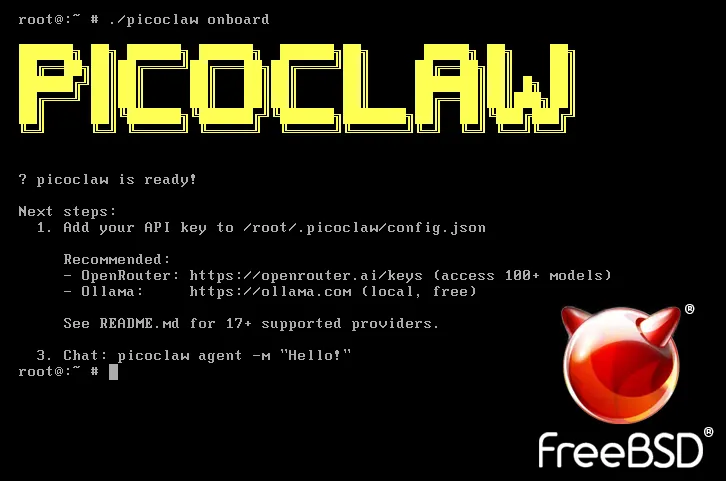
6 Build Targets Covered
Precompiled binaries for BSD — ready to run, no build required:
| Platform | Architectures |
|---|---|
| FreeBSD | x86_64 / arm64 / armv7 / armv6 |
| NetBSD | x86_64 / arm64 |
Fast download: picoclaw.io
Latest builds: github.com/sipeed/picoclaw/releases
No compilation needed, no Go environment required
Download, extract, run — three steps and you’re done
Why BSD Users Need PicoClaw
BSD systems have a massive installed base in servers and network appliances
These devices typically run 24/7, have limited resources, and aren’t suited for heavy applications
PicoClaw fits perfectly:
- 10 MB memory footprint — won’t interfere with your NAS or firewall’s main workload
- Single binary deployment — no dependencies, no runtime, just copy and run
- Millisecond startup — service resumes instantly after a reboot
Some typical use cases:
- TrueNAS / FreeNAS: Run an AI assistant on your NAS, remotely manage files and query storage status via Telegram
- pfSense / OPNsense: Deploy an AI ops assistant on your firewall for automated log analysis and alert forwarding
- NetBSD embedded devices: Run a lightweight agent on network appliances for automated health checks
- Development servers: BSD developers can finally use an AI assistant in their native environment
Community Feedback
The BSD support launch got a strong reception in the international tech community. A few interesting highlights:
- Someone ran it on a 2012 HP MicroServer (FreeBSD 14) with only 8 MB memory usage
- Someone dropped it into a Raspberry Pi 4 + FreeBSD homelab gateway
- A developer in the NetBSD community is testing packaging PicoClaw into pkgsrc
The BSD community is known for technical depth, resource sensitivity, and preference for lightweight tools
PicoClaw’s design philosophy is a natural fit
Get Started in Three Steps
Using FreeBSD x86_64 as an example:
Step 1: Download
fetch https://github.com/sipeed/picoclaw/releases/latest/download/picoclaw_Freebsd_x86_64.tar.gzNote: NetBSD users should install wget via pkgin or use curl to download
Step 2: Extract and Initialize
tar xzf picoclaw_Freebsd_x86_64.tar.gz
./picoclaw onboard
Step 3: Start Chatting
./picoclaw agentWant to connect Telegram, Discord, Feishu, or DingTalk?
Edit ~/.picoclaw/config.json to configure the channels, then run picoclaw gateway
Full documentation: docs.picoclaw.io
Full Platform Support
| Platform | Architectures |
|---|---|
| Linux | x86_64, arm64, armv7, armv6, riscv64, loong64, mipsle, s390x |
| macOS | arm64 (Apple Silicon), x86_64 |
| Windows | x86_64, arm64 |
| FreeBSD | x86_64, arm64, armv7, armv6 |
| NetBSD | x86_64, arm64 |
35 precompiled packages in total — from $5 dev boards to enterprise servers
PicoClaw — Lightweight, Cross-platform, Blazing Fast
Website: picoclaw.io
GitHub: github.com/sipeed/picoclaw
Docs: docs.picoclaw.io
Discord: discord.gg/V4sAZ9XWpN